

This buying guide focuses on the essential considerations when buying a red light therapy lamp. We share the key points to look out for, so you can make an informed decision that suits your needs and preferences.
7 things to look for when buying a red light therapy lamp
Key points to consider when buying a red light therapy lamp are:
- ✔Effectiveness: wavelength, irradiance and wattage.
- ✔EMF emissions and flicker
- ✔A treatment area that suits your needs.
- ✔A reliable brand with good reviews.
- ✔Proper safety certification.
- ✔Ease of use, such as timers and mounting options.
- ✔The warranty period.
In this article, we take a closer look at why these specifications matter and how they contribute to the effectiveness of the therapy, so you can be confident you are making the best choice for your situation.
Infrared lamp or red light therapy lamp: not the same thing
Search for ‘red light lamp’ and you will find two completely different products. The classic infrared heat lamp, the red bulb you may know from the pharmacy, uses an incandescent or halogen bulb. It emits a broad spectrum, mostly heat, and is designed to warm up a specific area.
A red light therapy lamp uses LEDs that emit very specific wavelengths: red light (around 630 and 660 nm) and near-infrared light (around 810 and 850 nm). The goal is not to heat, but to deliver light in the wavelengths used in photobiomodulation research. A lamp like this feels slightly warm at most.
| Infrared heat lamp | Red light therapy lamp (LED) | |
|---|---|---|
| Light source | Incandescent or halogen bulb | LEDs with fixed wavelengths |
| Spectrum | Broad, mostly heat radiation | Targeted: red and near-infrared |
| How it feels | Clearly warm to hot | Neutral to slightly warm |
| Typical use | Warming up a local area | Face, skin, recovery, body |
| Price guide | €40 – €120 | €250 – €5,000, depending on size |
If you are only looking for warmth, a heat lamp will do. If you want red light therapy as it is used in studies, you need an LED device with stated wavelengths and a measured light intensity. Read more about how red light therapy works.
The core of effectiveness: wavelength, intensity and wattage
The success of red light therapy essentially depends on getting three crucial specifications right: wavelength, intensity and wattage. The wavelength determines how deeply the light penetrates the skin; the intensity and wattage provide enough energy to stimulate cellular processes. Too little intensity can lead to suboptimal results or much longer sessions. That is why it is so important to check these parameters carefully when choosing a red light therapy lamp.
Wavelength: the right spectrum
To get the most out of red light therapy, a device needs to offer the right spectrum of wavelengths. This means it should include both red and near-infrared wavelengths, which work together to reach both the surface and the deeper layers of the skin and tissue.
Red light, with a wavelength of roughly 630 to 660 nanometres, reaches the upper layers of the skin and is mainly studied for skin applications, such as skin texture and a more even complexion. Near-infrared light, with a wavelength of roughly 810 to 850 nm, penetrates deeper and is studied for muscles, joints and recovery, among other things. The broader the spectrum within these windows, the more applications a single device can cover.

Irradiance
Irradiance is a crucial aspect of red light therapy that can significantly affect how effective a treatment is. It refers to the amount of light energy that reaches your skin per second, measured in milliwatts per square centimetre (mW/cm²). It is the most important number for comparing lamps.

Intensity determines how much light reaches the skin and tissue. Higher intensity means you can deliver the same amount of light in a shorter session, and more light reaches deeper tissue such as muscles and joints. Pay attention to two things when comparing:
- The distance. Intensity decreases the further you move away from the lamp. Only compare values measured at the same distance, for example 15 cm.
- The measuring method. Many brands measure with an inexpensive solar power meter, which misreads red and infrared light and gives values that are too high. A spectrometer gives an honest picture. If in doubt, ask how the values were measured.
Wattage
Wattage refers to the power of the lamp. A red light therapy lamp with low power may not deliver the results you are looking for. The number in a product name is usually the nominal power of the LED chips: the number of LEDs multiplied by the power per chip, not the actual power consumption.
Wattage is often higher on larger devices, but that is not always the case: the LED chips also play a role. A panel with 5-watt chips delivers noticeably more light than a panel of the same size with 2- or 3-watt chips. So always look at wattage and measured intensity together. A high wattage without a stated irradiance says little about what actually reaches your skin.
Often overlooked: EMF emissions and flicker
EMF emissions
EMF, an electromagnetic field, is emitted by all electronic devices. Because you sit close to a device every day with red light therapy, many users want this field to be as low as possible at treatment distance.
Many red light therapy devices on the market have overly complex and unnecessary electronic features, which leads to higher EMF emissions without much benefit to the user. A reliable brand measures the EMF value and publishes it at treatment distance.
Flicker
Many cheap brands use LEDs with a high flicker rate. Have you ever noticed that some LED lights seem to flash on and off rapidly on camera? Or walked into a room that felt like a strobe light was on? That is because the LEDs in these lights switch on and off rapidly to save energy. That is fine for most household lighting, but not for a lamp you sit directly in front of every day.

Although you may not notice the flicker straight away, many people find it unpleasant for their eyes. It can contribute to headaches and tired eyes. A flicker-free device is therefore much more comfortable for daily use.
A treatment area that suits your needs
The size of the lamp you need depends on the treatment area that fits your goals with red light therapy. It is important to choose a lamp of the right size, because intensity decreases the further away from the lamp you are. You may cover a larger area, but with much less effect.
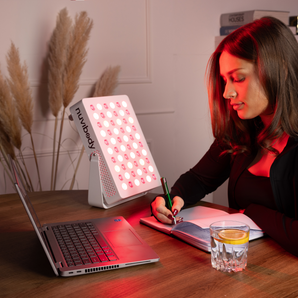
If you want to treat a local area, such as your face, neck, scalp, a strained muscle or a sore knee, a small panel or LED mask can be ideal. Larger panels are more effective for the back, legs or the whole body.
You can also use a small device for larger areas of the body, but you will need to reposition it several times and each session will take much longer.
| What do you want to treat? | Suitable type | Price guide |
|---|---|---|
| Face and neck | LED mask | €150 – €600 |
| Face, neck or a joint | Compact (desktop) panel | €250 – €500 |
| Back, torso or legs | Half-body panel | €900 – €1,800 |
| The whole body in one session | Full-body setup (multiple panels) | €2,000 – €5,000 |
Price guides are indicative and based on the typical range available in Europe.
Peace of mind: final points to consider
1. A reliable brand with good reviews
Choose a lamp from a reliable brand with a good reputation. Read online reviews from other users to see what their experiences are with the brand and the specific device you are considering. Look for brands with good customer service and a European contact address.
2. Proper safety certification
Make sure the lamp is CE certified and complies with the RoHS and EMC standards. A CE logo on the box says little on its own; a reliable supplier can show you the declaration of conformity. We strongly advise you to avoid lamps that do not meet these standards.
3. Ease of use
Choose a lamp that is easy to use. Look for a timer that switches the device off automatically after the treatment time, quiet fans, and mounting options or a stand, so you can position the device easily. Eye protection should be included as standard.
4. The warranty period
A good warranty gives you confidence in the quality of the device. Most suppliers offer a 1 to 2-year warranty. Also check whether you can try the lamp at home without pressure.
How we measure light intensity
We measure the irradiance of our panels with a spectrometer, directly in front of the centre of the lamp, at a distance of 15 centimetres. That is the distance at which most users do their treatment. This keeps the values fairly comparable and not inflated by a measuring method that misreads red and infrared light.

| Device | Irradiance at 15 cm | Wavelengths | LEDs |
|---|---|---|---|
| CORE 300 | 81 mW/cm² | 660 and 850 nm | 60 × 5W dual chip |
| CORE 1500 | 88 mW/cm² | 630, 660, 810 and 850 nm | 300 × 5W |
Measured with a spectrometer at a distance of 15 cm, centre of the panel. The value decreases at greater distances.
Which red light therapy lamp should I choose?
Choosing the right red light therapy lamp can be challenging, but at Nuvibody we make it simple. Our devices are designed around exactly the points in this buying guide: flicker-free LEDs, an EMF of 0.00 µT at treatment distance, CE and RoHS certification, a 3-year warranty and 120 days to try at home. They come with eye protection and a mounting system or stand.
Which device suits you best depends on what you want to treat:

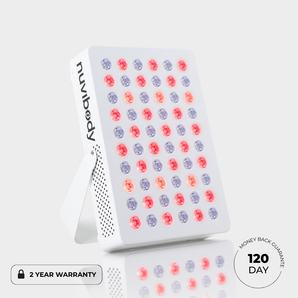
CORE 300
This compact and affordable device is the ideal entry-level model. Place it easily on a table and start targeted treatments of your face or specific areas of the body straight away.

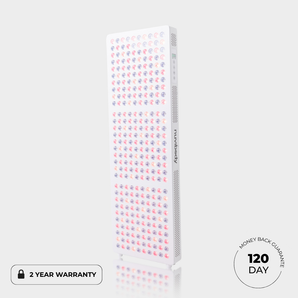
CORE 1500
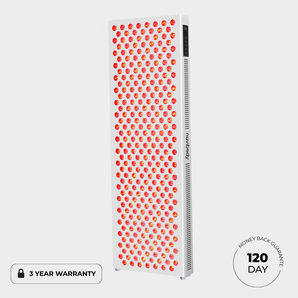
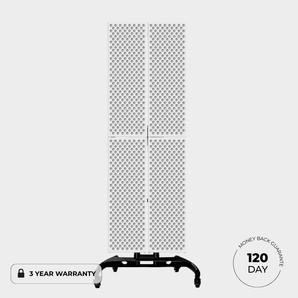
Our most powerful single panel, with four wavelengths, for the back, torso or legs. Ideal for home users and professionals, and expandable to a full-body setup later.

CORE 1500 DUO
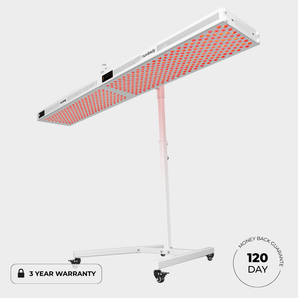
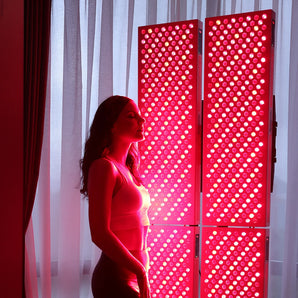
Two linked panels: treat your whole body in one session, without having to move the device.

AURA+ LED mask
A flexible mask with a décolleté piece, 232 triple-chip LEDs and 7-minute sessions. Hands-free and easy to fit into your daily skincare routine.
Want to treat your front and back at the same time, or looking for a setup for intensive or professional use? Then the CORE 1500 QUAD, with four linked panels, is the most complete choice.
Still not sure? Compare all our panels side by side and find the size that fits your goals and space.
View all panelsFrequently asked questions
What is the best red light therapy lamp?
The best lamp depends on what you want to treat. For your face only, an LED mask is the most practical; for targeted areas, a compact panel; and for larger areas of the body, a half-body panel or a full-body setup. Also look for both red and near-infrared light, a measured intensity at treatment distance, flicker-free LEDs and CE certification.
Why is power density important in red light therapy?
Power density (irradiance) indicates how much light energy reaches your skin per second. Higher power density means you deliver the same amount of light in a shorter session. Devices with low power density require much longer sessions. Always compare values at the same distance, ideally measured with a spectrometer.
Is an infrared heat lamp from the pharmacy the same as red light therapy?
No. An infrared heat lamp uses an incandescent or halogen bulb and mainly emits heat across a broad spectrum. A red light therapy lamp uses LEDs with specific red and near-infrared wavelengths and barely feels warm.
Why does flicker matter in red light therapy?
Because you sit directly in front of the lamp every day. Many people find flickering LEDs unpleasant, and they can contribute to headaches or tired eyes. A flicker-free device makes the treatment more comfortable.
Why do low EMF emissions matter in red light therapy?
Because you regularly sit close to an electronic device during red light therapy, many users want the electromagnetic field to be as low as possible at treatment distance. A reliable brand measures this and publishes the value.
Has red light therapy been scientifically studied?
Yes, there is a growing body of research on red light therapy (photobiomodulation), including on skin, muscle recovery and pain. Results vary by application and by study. You can find an overview on our science page.
What is the difference between Nuvibody and other brands?
Nuvibody publishes the irradiance of every panel as measured with a spectrometer at 15 cm, uses flicker-free LEDs with 0.00 µT EMF at treatment distance, and supplies all devices with CE and RoHS certification, a 3-year warranty and 120 days to try at home.