

Red Light Therapy and Football: Faster Recovery, Fewer Injuries
Football players strain their hamstrings, knees, and head more heavily than most athletes. Premier League club Fulham FC announced an official partnership in early 2026 to integrate red light therapy into their player recovery, and more and more top European clubs are following suit. This article shows what research specifically demonstrates in football players, how you can use it yourself around training sessions and matches, and what equipment suits your level. And yes, it's allowed: red light therapy is not on the WADA Prohibited List 2026, so from amateur teams to professional contracts, you can play without worries.
Does red light therapy really work for football players?
Yes, and there is research specifically on football players. In a randomized study from 2019 with 22 high-level football players, 810nm infrared light before a progressive treadmill test increased antioxidant enzymes (SOD and catalase) and decreased markers for oxidative damage and muscle damage after exertion. A 2015 meta-analysis in Lasers in Medical Science covering 46 randomized studies confirms the same trend: pre-exercise photobiomodulation reduces muscle damage and accelerates recovery.
What this means for you: less muscle breakdown per match, faster return to peak performance, and less cumulative damage over a season. The effect on pure maximal strength is not significant in research, so see it as a recovery accelerator, not a performance booster for strikers. For amateurs, this is especially valuable: you don't have a club physiotherapist or cryotherapy at hand, so every effective home recovery method counts. If you want a deeper understanding of the evidence, read our page on the scientifically proven benefits of red light therapy.
How does red light therapy accelerate muscle recovery after a football match?
The light activates the mitochondria in your muscle cells, which start producing more ATP. More cellular energy means that micro-tears in hamstrings, quadriceps, and calves are repaired faster, and inflammatory responses subside more quickly. Simultaneously, blood flow improves, accelerating the removal of waste products. This same mechanism indirectly supports electrolyte balance and muscle function, which reduces the risk of cramps in the week before a tough match.
The combination of red light (630nm and 660nm) and near-infrared (810nm and 850nm) is important for football players. Red light works on the skin and superficial muscle layers, while infrared penetrates deep into muscles, tendons, and joints. A panel with all four wavelengths thus addresses both your calf muscles and your knee and hip capsules.
When to use red light therapy: before or after the match?
Both are possible, but the timing differs per goal. For pre-match (pre-conditioning), irradiate your legs for 5 to 10 minutes approximately 30 to 60 minutes before kick-off. This increases antioxidant capacity and prepares your muscles for the oxidative stress that follows, exactly as shown in the 2019 football study.
After the match, the focus is on recovery: 10 to 15 minutes per zone, ideally within two hours after the final whistle. Many users already notice within one to three sessions that muscle soreness the next day is less intense. On rest days, an evening session works doubly: muscle recovery plus better sleep quality due to increased melatonin production. You can read how sleep enhances recovery in our guide on red light and sleep.
Does it help with hamstring, knee, and ankle injuries in football players?
For each of these common football injuries, red light therapy provides support, provided you use it consistently. Hamstring strains benefit from 810nm and 850nm which penetrate through the skin and overlying tissue into the muscle belly. For knee problems (jumper's knee, meniscus irritation, mild osteoarthritis), the anti-inflammatory effect alleviates pain and accelerates cellular-level recovery. For sprained ankles, it supports ligament healing and helps reduce swelling more quickly.
For structural complaints, count on 4 to 6 weeks of daily use before you notice a clear difference. Don't give up earlier, the effect builds up. Feel free to combine it with physiotherapy or sports massage: red light enhances regeneration at a cellular level, while physiotherapy and massage address the mechanical and neuromuscular aspects. Many Dutch physiotherapists now integrate red light into their treatment plan; a typical combination is 10 minutes of light before or after your physio session. A complete explanation of its application for injuries can be found on the page about red light therapy for pain relief.
Can red light therapy reduce brain inflammation from heading?
Research on this is still in its early stages but points in an interesting direction. The University of Utah published a study in early 2026 in the Journal of Neurotrauma where 26 NCAA Division 1 American football players received 20 minutes of transcranial near-infrared light (810nm) three times a week throughout an entire season. The placebo group showed a significant increase in inflammatory markers and a decrease in white matter integrity, while the treated group maintained its microstructural stability.
Important: this study was about American football, not soccer. But the underlying mechanism, brain inflammation from repetitive head impact, is related to what soccer players experience when heading and in tackles. For Dutch soccer players, especially youth players who head the ball weekly, this is relevant but not yet direct proof. Consumer panels have not been specifically tested for transcranial application, so consider it an additional layer, not a replacement for medical advice in case of concussion. For youth under 16, we recommend consulting a GP or sports doctor first and keeping session times short: 5 to 7 minutes per zone is sufficient for youth players.
Which top clubs use red light therapy?
Fulham FC announced a multi-year recovery partnership in February 2026 integrating red light therapy, PEMF, and infrared sauna directly into their player program. The Premier League club uses it for sleep quality, energy, and recovery between matches, precisely the three areas where footballers lose the most time. Across the Atlantic, NFL team San Francisco 49ers has had a dedicated light therapy room in their stadium since 2019.
The application in a Premier League context is practically identical to what you can do at home: focused on muscle recovery immediately after the match, anti-inflammation the day after, and locally for injuries in rehabilitation. The difference lies in the wattage and surface area of the panels, not in the principle.
Which device is suitable for a football player?
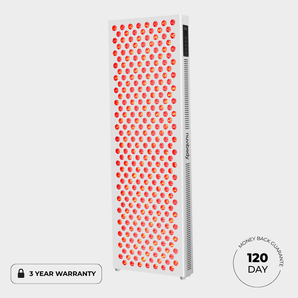
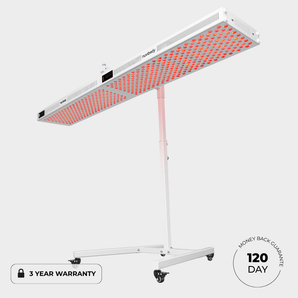
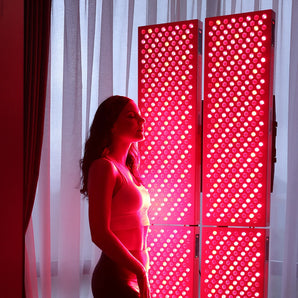
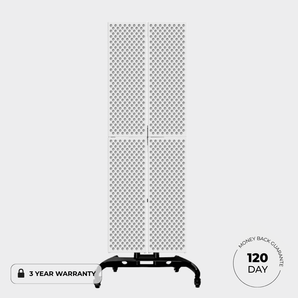
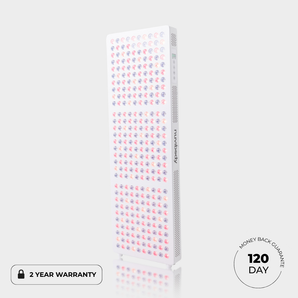
That depends on how often you play and what you primarily want to address. For full-body recovery after training and matches, a CORE 1500 panel with four wavelengths (630, 660, 810, and 850nm) and 1500 watts of power is the logical choice. You treat your entire legs or torso in one 10-minute session.
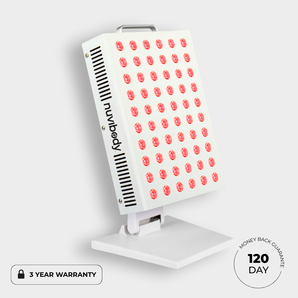
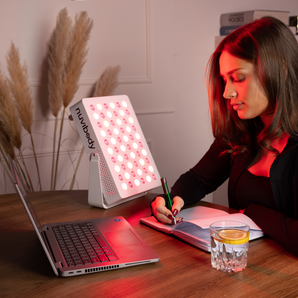
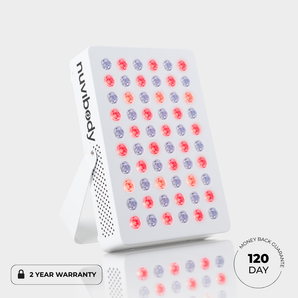
For targeted treatment of a specific injury or for on the go to an away match, the compact CORE 300 works better. Both models are covered by the 120-day trial period, so you can test whether it has an effect on your recovery over half a football season. All Nuvibody panels comply with CE, RoHS, and EMC standards and are manufactured in an ISO-certified facility.
Would you like to know which model suits your situation?
Contact us via support@nuvibody.com or call +31 85 250 2810 for personal advice from someone who knows the panels firsthand.
How to apply red light therapy as a football player: Concrete protocol
Adhere to this weekly schedule for visible results within 4 to 6 weeks. Place the panel 15 to 45 cm from the skin, choose the combination of red + near-infrared, and ensure the light beam covers your entire target area.
- Match day: 5-10 minutes for legs before the match, 10-15 minutes for legs and lower back within 2 hours after the final whistle.
- Intense training: 10 minutes immediately after training, focused on the most heavily stressed muscle groups.
- Rest days: 10 minutes in the evening, full body if possible, supports sleep and overall recovery.
- Injury rehabilitation: 2 sessions per day of 10 minutes, focused on the affected area, for 4-6 weeks.
- Maintenance (no match or intense training): 3 sessions per week of 10 minutes are sufficient.
For the complete biological background, read how red light therapy works at a cellular level. There you will see why timing and wavelength make such a difference.
Conclusion
For football players, red light therapy is not a gimmick but a sound, evidence-based recovery method. The benefits include less oxidative damage, faster recovery from micro-traumas, and possibly protection against cumulative brain inflammation in contact sports. It won't provide extra top speed, but it will result in more matches played at a high level per season and fewer weeks spent in the physio bunker.
Start with 3 to 4 sessions per week of 10 minutes, choose a device with all four relevant wavelengths, and give it 6 weeks before drawing conclusions. This is exactly why Nuvibody offers a 120-day trial period.