

Red light therapy and eczema: what the research shows so far
Meta title: Red light therapy and eczema: what does the research show?
Meta description: Red and near-infrared light calms inflammation in the skin, and the early eczema research looks promising. What has been found, what is still unknown, and how to try it.
Short answer
|
Red light calms inflammation in the skin, and so does near-infrared, the invisible light just beyond red that reaches a little deeper. The eczema research so far points the same way. In mice with an eczema like skin condition, red light left them scratching less, with less inflammation and less thickened skin. In a study of 112 people with eczema treated with near-infrared light, 71 percent had less itch and 62 percent saw their rash improve, and skin samples showed that the inflammation itself had settled down. Nobody reported side effects. This is early evidence rather than an established treatment, because it has not yet been tested in a modern trial using a home panel. We think it is promising enough to be worth trying alongside your usual care. The light therapy with the most backing in medical guidelines is UVB, which you get through a dermatologist. |
Eczema, or atopic dermatitis, is a long-term skin condition. The skin barrier is weakened, the immune system overreacts, and the result is inflammation, itch and the scratching that makes it worse. Most people with eczema are looking for something extra to go alongside their creams and medication. Red light therapy gets talked up more than the evidence allows, and it also gets dismissed more than the evidence allows. Here is where it actually stands.
Why light is a sensible place to look
Red and near-infrared light is thought to be absorbed by mitochondria in skin cells, which is proposed to calm inflammation and support repair of skin tissue itself (Avci et al., 2013). It is the same effect behind the uses where red light already has solid evidence from proper trials, such as wound healing and collagen production.
So when researchers started looking at eczema, they were not guessing. They were taking something that already works on inflammation and skin repair, and applying it to a condition built on exactly those two problems.
What has been found so far
In animals: the same effect showing up three ways
The most thorough study to date treated mice that had an eczema like skin condition with red light, fourteen times over two weeks. Every group that got the light scratched less and had milder skin symptoms than the untreated group. Blood tests showed lower levels of the substances that drive the inflammation. And under the microscope, their skin was less thickened and held fewer of the immune cells that release itch-causing chemicals (Kim et al., 2021).
That is a strong result for this stage. The improvement turned up in what the animals did, in what their blood showed and in the skin tissue itself, all at the same time, which is far harder to explain away than a single positive measurement. The wavelength was close to a panel's red output and the energy dose was in a similar range, though it came from a laser rather than an LED array. It is still an animal study, so how well this carries over to a person is the open question.
In people: 112 patients treated with near-infrared light
In a study of 112 people with eczema treated with near-infrared light, 71 percent reported less itch and 62 percent saw their rash improve, with no side effects reported. The researchers also took skin samples, and those showed that the immune activity behind the inflammation had quietened down (Morita et al., 1993). That last point matters, because it means the improvement was not only in how people felt. Something measurable had changed in the skin.
The wavelength, 830 nm, is close to the near-infrared in a modern panel. But it was delivered by laser, and the paper does not report the dose or the number of sessions, so how far it transfers to a panel is genuinely unclear. Two things do limit what we can conclude from it. There was no comparison group, so the effect of the light cannot be fully separated from natural ups and downs and from the expectation of getting better. And the light came from a medical device rather than an LED panel. Wider reviews of LED treatments in skin medicine describe red light as a plausible option for inflammatory skin conditions, and note that eczema trials are still thin on the ground (Ngoc et al., 2023; Jagdeo et al., 2018).
One note on blue light
The most rigorous light studies in eczema so far have actually used blue light rather than red. A randomised study, the kind where patients are put into a treatment or a comparison group by chance, treated 21 patients with blue LED light and found a bigger drop in eczema severity in the treated patches than in the untreated ones, and a larger randomised trial using full-body blue light has since been run (Keemss et al., 2016; Kromer et al., 2019). It is worth knowing about, because when you read online that light helps with eczema, that is often the research being referred to, and it is a different colour of light from a red panel.
What it all adds up to
Red light for eczema has a mechanism that is well established in skin, animal results that line up across three different kinds of measurement, and a substantial study in people pointing the same way. What is missing is the last step: a modern randomised trial using a red panel on people with eczema. That is a real gap. It is also the normal position for a promising treatment that has not had a big trial run on it yet, rather than a sign that the idea is falling apart.
Two things follow from that. Nobody can give you a proven dose for eczema specifically, so the sensible approach is to follow the standard instructions for your panel rather than some special eczema routine. And treat pages that call this settled science with caution: the randomised trial they most often cite does not turn up anywhere in the scientific databases when you go looking for it. Everything on this page comes from studies we checked ourselves.
Red light and UVB are not the same thing
The light therapy doctors use for eczema is UVB. It appears in international guidelines as an option for people whose creams and ointments are not enough (Davis et al., 2024). Even there it comes with a caveat: the recommendation is a conditional one, based on evidence the guideline itself calls limited, and a Dutch trial called UPDATE is running now to firm that up (Knoeps et al., 2024;25:482.). UVB has more behind it than red light does, but it is not a closed case either.
Red light and near-infrared are a completely different kind of light from UV, and contain no UV at all. That means no burning, no UV damage to the skin, and no lifetime exposure to keep track of. It also means the evidence for UVB tells you nothing about red light in either direction. If you want the option with the most support in the guidelines, start with your GP or dermatologist. Red light is something you can run alongside it.
What customers tell us
Plenty of people with eczema use a panel and tell us their skin is calmer and itches less. We hear it often, it matches what the research above would predict, and it is part of why we think this deserves a proper trial. Eczema does come and go on its own, so one good month proves nothing by itself. Taken together with the mechanism and the studies, though, these reports are a reason to take the idea seriously.
How to try it, and what to watch for
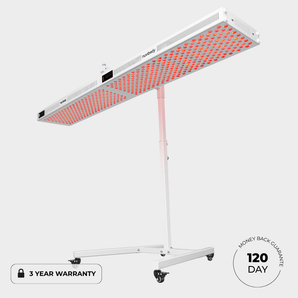
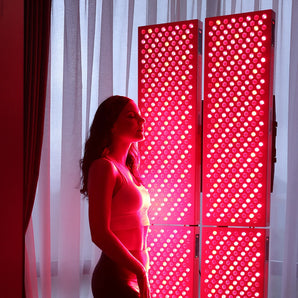
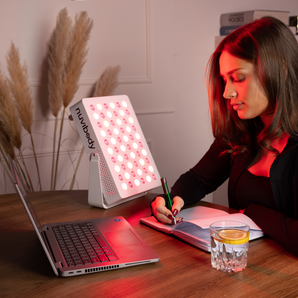
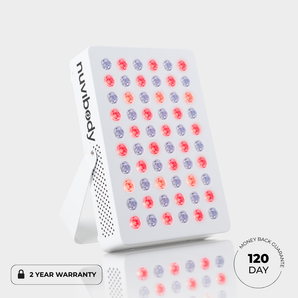
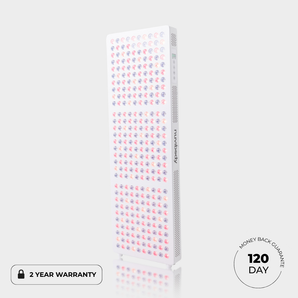
Red light contains no UV, and a panel is built to give off light rather than heat. At the recommended distance you will feel a mild warmth, not enough to genuinely heat your skin. A few things are worth knowing before you start.
-
Follow the distance, session length and frequency in your manual, and give it a consistent run of several weeks. Being regular about it matters more than long sessions.
-
Start with one area and build up, so you can see how your skin reacts before you treat more of it.
-
Heat and sweat set off eczema in some people. If that is true for you, keep to the recommended distance and start with shorter sessions. It is a personal sensitivity worth checking rather than a general risk of the device.
-
If your eczema is weeping, infected or getting worse quickly, see a doctor first before you add anything yourself.
-
Check with your doctor if you take medication that makes you more sensitive to light, and do not look straight into the LEDs.
Keep the basics going underneath all of this. A rich, fragrance-free moisturiser applied generously and often is what supports the skin barrier, and anti-inflammatory ointment during a flare-up is still the treatment with the strongest evidence behind it. Red light is an addition to that, not a swap. Knowing your own triggers helps as well, whether that is soap, dust, heat or stress. And if your eczema is not under control, your GP or dermatologist can look at UVB or, for severe eczema, at medication.
Where red light has the most evidence
Skin is the area where red light is best researched overall. For skin rejuvenation, collagen production and wound healing there are proper randomised trials in people, and that is where the effect behind the eczema research was first pinned down. If you want to support dry, ageing or damaged skin at the same time, have a look at our collection face and skin. To see how red light stands for other conditions, read red light therapy for psoriasis or our overview of red light therapy for diseases and conditions, which sets out how strong the evidence is for each one.
Thinking of trying it?
It is a reasonable thing to do, as long as you know what you are buying. You are adding something with a proven mechanism and encouraging early results to care that already works, not replacing one with the other. Keep moisturising, stay on your treatment plan, and watch how your skin responds.
Our 120-day trial gives you room to treat it as an experiment on yourself: give it a fair run over several weeks, keep everything else the same, and send it back without fuss if nothing changes. That will not settle whether red light works for eczema in general, but it will answer the question you actually care about, which is whether it does anything for you. Not sure whether it suits your situation? Call us on +31 85 250 2810 or email support@nuvibody.com. If we think it will not add much for you, we will say so.
Frequently asked questions
Does red light therapy help with eczema?
The research points that way. The effect it has on inflammation is well established in skin, animal studies show less scratching and less inflammation, and a study of 112 people found a clear improvement in itch and rash. It has not yet been confirmed in a modern trial using a home panel, so be careful with pages that call it proven.
How long before I would notice anything?
There is no proven schedule for eczema, so go by the instructions for your panel and give it a consistent run of several weeks before you judge it. Eczema comes and goes by itself, which is why a longer stretch tells you more than a handful of sessions.
Is red light the same as the light therapy at the hospital?
No. Hospital light therapy for eczema is UVB, a different kind of light altogether and the option with the most support in the guidelines, though that recommendation comes with caveats. A red light panel is not a UVB lamp and does not replace one.
Does a panel make my skin warm, and is that a problem?
A panel is built to give off light rather than heat. At the recommended distance you will feel a mild warmth, not enough to really raise your skin temperature. If you know that heat and sweat set off your eczema, keep your distance and start with shorter sessions.
Can I stop my cream or ointment if I use red light?
No. Moisturiser and anti-inflammatory ointment are the best-supported part of eczema care, and stopping them will almost certainly bring on a flare-up. Use red light alongside them.
Should I apply cream before or after a session?
Use the panel on clean skin and apply your cream afterwards. What matters far more than the timing is that you keep moisturising.
Sources
Davis DMR, Drucker AM, Alikhan A, et al. Executive summary: guidelines of care for the management of atopic dermatitis in adults with phototherapy and systemic therapies. Journal of the American Academy of Dermatology. 2024;90(2):342-345. https://doi.org/10.1016/j.jaad.2023.08.103
Knops E, Spuls P, Duijnhoven R, et al. The UPDATE trial (UVB Phototherapy in Dermatology for ATopic Eczema): study protocol for a randomized controlled trial of narrowband UVB with optimal topical therapy versus optimal topical therapy in patients with atopic eczema. Trials. 2024;25:483. https://doi.org/10.1186/s13063-024-08334-z
Morita H, Kohno J, Hori M, Kitano Y. Clinical application of low reactive level laser therapy (LLLT) for atopic dermatitis. Keio Journal of Medicine. 1993;42(4):174-176. https://doi.org/10.2302/kjm.42.174
Kim YL, Lim HS, Lee SM. Effect of low-level laser intervention on dermatitis symptoms and cytokine changes in DNCB-induced atopy mouse model: a randomized controlled trial. Experimental and Therapeutic Medicine. 2021;22(5):1196. https://doi.org/10.3892/etm.2021.10630
Keemss K, Pfaff SC, Born M, Liebmann J, Merk HF, von Felbert V. Prospective, randomized study on the efficacy and safety of local UV-free blue light treatment of eczema. Dermatology. 2016;232(4):496-502. https://doi.org/10.1159/000448000
Kromer C, Nühnen VP, Pfützner W, et al. Treatment of atopic dermatitis using a full-body blue light device (AD-Blue): protocol of a randomized controlled trial. JMIR Research Protocols. 2019;8(1):e11911. https://doi.org/10.2196/11911
Ngoc LTN, Moon JY, Lee YC. Utilization of light-emitting diodes for skin therapy: systematic review and meta-analysis. Photodermatology, Photoimmunology and Photomedicine. 2023;39(4):303-317. https://doi.org/10.1111/phpp.12841
Jagdeo J, Austin E, Mamalis A, et al. Light-emitting diodes in dermatology: a systematic review of randomized controlled trials. Lasers in Surgery and Medicine. 2018;50(6):613-628. https://doi.org/10.1002/lsm.22791
Avci P, Gupta A, Sadasivam M, et al. Low-level laser (light) therapy (LLLT) in skin: stimulating, healing, restoring. Seminars in Cutaneous Medicine and Surgery. 2013;32(1):41-52. https://doi.org/10.12788/j.sder.0003
This article is for information only and does not replace medical advice. Eczema belongs with your GP or dermatologist. Always speak to a doctor before you change anything about your treatment.