

Red Light Therapy for Wound Healing
Wound healing is not a singular process. After an injury, the body goes through three consecutive phases: inflammatory phase, proliferative phase, and maturation phase. Red light therapy is effective because it intervenes in each of these phases, in a different way and with a different result. That makes it more than just "shining light on a wound."
Phase 1: The Inflammatory Phase (Day 1 to 5)
Immediately after an injury, the body reacts with an inflammatory response: redness, swelling, and heat. This is normal and necessary, but prolonged or overly severe inflammation slows down recovery.
Red light therapy reduces the production of pro-inflammatory cytokines, which decreases redness, swelling, and pain around the wound. By modulating inflammation without completely suppressing it, it helps the body move to the next phase more quickly.
Phase 2: The Proliferative Phase (Day 4 to 3 Weeks)
In this phase, the body builds new tissue. Fibroblasts produce collagen, new blood vessels grow, and the wound closes. This is the phase where red light does most of its work.
Red light therapy stimulates fibroblasts to produce type III collagen, which is more flexible and stronger than the collagen normally formed during scarring. This is crucial for a functional and aesthetically better end result.
At the same time, the therapy improves microcirculation around the wound. The light waves enhance local blood flow and activate immune cells in the wound area, allowing the body to fight harmful bacteria more quickly and reduce the chance of infections.
Phase 3: The Maturation Phase (Weeks to Months)
The wound is closed, but the scar tissue continues to reorganize for months. Here, the quality of the collagen formed determines how visible and palpable the scar ultimately becomes.
Continuing with red light in this phase pays off. By continuing to modulate inflammation, red light therapy can help reduce the excessive or uncontrolled production of collagen, such as in hypertrophic scars or keloids.
What types of wounds is it suitable for?
Red light therapy has broad applications: cuts and abrasions, surgical scars once the skin is closed, burns (superficial, after medical treatment), acne scars, and diabetic wounds where healing is slower.
Important caveat: for severe wounds, open infections, or burns, medical treatment is always primary. Red light therapy is a supplement, not a replacement.
When to start?
Not on an open wound. Wait until the wound is completely closed. After that, the sooner you start, the more influence you have on the quality of the scar tissue that forms. The early proliferative phase offers the most therapeutic opportunity.
How to apply it?
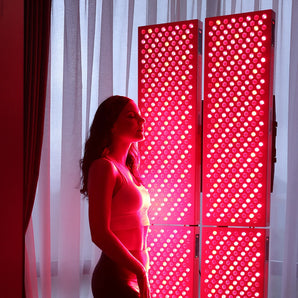
Use wavelengths from 630 to 660 nm for superficial wound healing, possibly supplemented with 810 to 850 nm near-infrared if the tissue is deeper. Maintain a session duration of 10 to 20 minutes, at a distance of 15 to 30 cm, 2 to 5 times per week. Treat on clean skin, without creams or ointments applied, so that the light directly reaches the skin.