

For most purposes, 3 to 5 sessions per week of 10 to 20 minutes works best. But that answer is too crude to work with. The optimal frequency depends on your goal, your panel's power, and a scientific principle many people overlook: the biphasic dose-response. In this article, we explain why more is NOT always better, how often you should treat for each type of complaint, and how to build a progressive schedule that you can maintain for 6 months without dropping out.
The short answer: how often per week?
For the vast majority of applications, 3 to 5 sessions per week are sufficient. Not 7. Not 2. There's a biological reason behind this, not marketing talk. Below are the guidelines per goal based on clinical studies:
- Skin improvement (acne, fine lines, scars): 3-5x per week, 10-15 minutes per zone
- Muscle recovery after exercise: 2-3x per week, 10 minutes immediately after exertion
- Chronic pain (osteoarthritis, back pain): 4-7x per week in the build-up phase, then 3-4x for maintenance
- Sleep and energy: 3-4x per week, 10-15 minutes in the evening
- General well-being and prevention: 3x per week, 10 minutes full body
Give your body at least 4 to 6 weeks to notice something. For acute complaints (a sprain, muscle soreness after a match), many users see effects within 1 to 3 sessions, but structural improvement builds up over weeks.
Why is more NOT always better?
Red light therapy follows the biphasic dose-response (also called the Arndt-Schulz curve). That sounds complicated but simply means: too little light does nothing, the right amount gives a positive effect, and more than that optimum makes the effect smaller or even negative. Researcher Michael Hamblin of Harvard Medical School has extensively documented this principle in his work on photobiomodulation.
What that means in practice: an hour daily behind a 1500-watt panel does not work better than 10 minutes 4 times a week. In fact, higher doses can overstimulate your cells and counteract the effect. It's not a painkiller where you take more for a greater effect. It's more like exercise: effective training 3 times a week gives better results than exhausting yourself every day.
How often per week per goal: a concrete breakdown
Skin improvement and anti-aging
For acne, fine lines, scars, and skin rejuvenation, 3 to 5 sessions per week is the gold standard in clinical research. Expect 4 to 8 weeks for the first visible improvement in wrinkles or texture. A session on the face or décolletage takes 10 to 15 minutes at a distance of 15 to 30 cm. The AURA+ LED Mask is specifically designed for this and fits into your evening routine. For smaller targeted areas such as a cheek or forehead, the compact CORE 300 is also a strong option.
Pain relief and chronic conditions
For pain, the frequency is higher: 4 to 7 sessions per week in the first 2 to 4 weeks to break the inflammatory cycle. For acute complaints (sprain, muscle tear, flare-up of osteoarthritis), you can even treat daily in the first week. Then reduce to 3 to 4 maintenance sessions per week. A recent systematic review from 2026 in Frontiers in Integrative Neuroscience compiled 14 randomized studies on chronic pain and concluded that photobiomodulation provides clinically relevant pain reduction for fibromyalgia, neuropathy, and musculoskeletal complaints. Read more about the application on our page about red light therapy for pain relief.
Sport recovery and muscle building
Athletes benefit most from 2 to 3 sessions per week, ideally immediately after intense training or within 2 hours after a competition. More often than that yields no extra gain. For an explanation of why timing is more important than frequency in sports, also see how red light therapy works at the cellular level.
Sleep, energy, and general well-being
Here, 3 to 4 sessions per week in the evening works best, as red light supports melatonin production and thus improves sleep quality. Read our guide on red light and sleep for the complete evening protocol.
How many minutes per session?
10 to 20 minutes per zone is the sweet spot in almost all studies. Shorter than 5 minutes provides insufficient dosage, longer than 25 minutes in one spot has no added value and simply costs you time. Stick to:
- Face and skin: 10-15 minutes at 15-30 cm distance
- Muscles and joints: 10-20 minutes at 15-30 cm distance
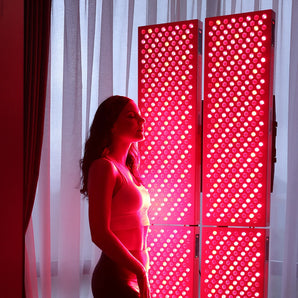
- Full body session: 10-15 minutes at 30-45 cm distance
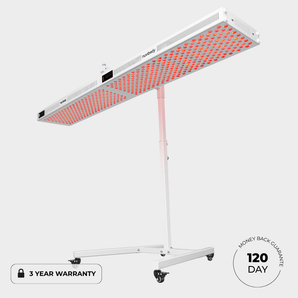
The power of your panel partly determines this time. A CORE 1500 with 1500 watts provides a higher intensity per cm² of skin than a LITE 300, so you need slightly less time for the same dosage. Both work fine as long as you adhere to the recommended session duration.
At what time of day is red light therapy most effective?
There is no scientifically superior time, but there are practical preferences depending on your goal. Morning sessions provide an energy boost and are well-suited for focus and alertness. Evening sessions support relaxation and sleep, especially if your goals are related to stress, sleep quality, or skin rejuvenation.
For athletes, immediately after training or within 2 hours after a competition is the timing most studies adhere to. What's most important, regardless of the time: choose a fixed time that fits into your daily routine. Consistency wins over perfect timing.
How to build up frequency when you're just starting out?
Our recommendation to new users: don't start immediately with 5 sessions per week. Build up gradually so your body gets used to it and you develop a routine that is sustainable.
- Week 1-2: 3 sessions per week, 8-10 minutes per session
- Week 3-4: 4 sessions per week, 10-12 minutes per session
- Week 5 and beyond: 4-5 sessions per week, 10-15 minutes per session
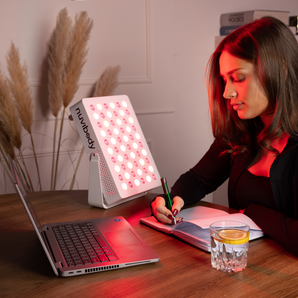
This build-up helps to prevent two things: overstimulation in the first week (some people experience temporary fatigue or mild headaches with too high a dosage too quickly) and dropping out because it takes too much time to maintain. For those just starting out and wanting to discover if it suits them without a large investment, the LITE 300 is an accessible starting point.
Can you do red light therapy every day?
Yes, daily use is safe and in some situations even recommended. For chronic pain, a flare-up of an injury, or in the first weeks of a skin treatment, you can easily treat 7 days a week. However, for most users with general well-being goals, daily use is unnecessary, as the biphasic principle ensures that your returns diminish. Three to four rest days per month give your cells time to fully process the signals.
How do you know if you're doing it right?
Three practical signs that indicate your frequency and dosage are correct:
- Within 1-3 sessions: improved sleep, lighter feeling, less acute pain
- Within 4 weeks: visible skin improvement, structurally fewer complaints
- Within 8-12 weeks: clear progress on your main goal, or determination that it doesn't work for you
If you don't notice anything after 12 weeks with correct dosage and frequency, red light therapy is probably not the solution for your specific complaint. That's part of honest expectations. That's why Nuvibody offers a 120-day trial period: over 16 weeks to discover if it works for you without financial risk.
Common mistakes in frequency
Treating too short, with too much time in between. Once a week for 5 minutes does little biologically. Your cells receive insufficient stimulus to make adaptations.
Too long per session. 45 minutes in one spot is no more effective than 15 minutes. A waste of your evening.
Stopping after 2 weeks. Many complaints require 6-8 weeks before you notice it. Those who stop too early miss the turning point.
Inconsistent distance. One session at 10 cm, the next at 60 cm. Keep your distance consistent, otherwise you cannot measure your progress.
Doing your face but your goal is elsewhere. For knee complaints, point the panel at your knee, not at your whole body hoping it will "end up" somewhere.
Which panel suits your frequency plan?
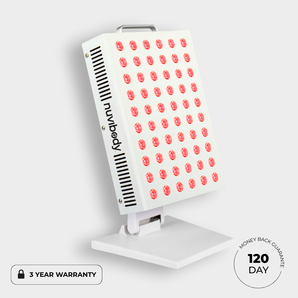
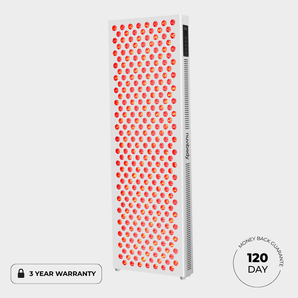
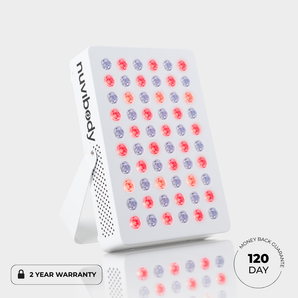
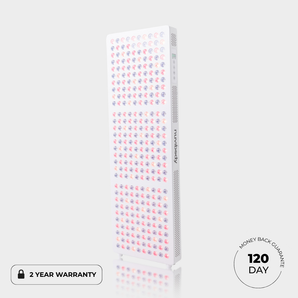
For 3 to 5 sessions per week of 10 to 15 minutes, you need a panel that covers enough surface area so you don't have to endlessly reposition it. The CORE 1500 treats your entire legs or torso in one session, ideal for people with multiple goals or large treatment areas. The more compact CORE 300 is stronger for targeted facial or pain point treatments, and the LITE 300 is an accessible starting point for those who want to explore it without a large investment.
All Nuvibody panels work with multiple wavelengths and comply with CE, RoHS, and EMC standards. Unsure which model suits your frequency and goal? Call +31 85 250 2810 or email support@nuvibody.com for personalized advice.
Conclusion
How often you use red light therapy depends on your goal, but for 9 out of 10 users, 3 to 5 sessions per week of 10 to 20 minutes is the right frequency. More is not better; the biphasic dose-response ensures that higher dosages can actually counteract the effect. Build up gradually in the first 2 weeks, choose a fixed time that fits into your daily routine, and give it at least 6 to 8 weeks before drawing conclusions. A panel with sufficient power and the right wavelengths makes the difference between a hobby and a method that truly yields results.