

Red Light Therapy Before and After: What Are Realistic Results?
An honest page about what red light therapy does and doesn't do, with week-by-week expectations per goal. We don't show marketing before-and-after photos, but we do present clinical study results with concrete measurements and published images from peer-reviewed research. Plus, what Nuvibody customers describe in their reviews, and how to responsibly track your own progress.
Why no marketing before-and-after photos?
Before-and-after photos in the red light therapy industry are often misleading. Lighting, angle, filtering, and makeup can completely determine the difference between "wow" and "nothing." A photo that seems to serve as proof usually says more about the photographer than about the panel.
What we do show: images and data from clinical studies published in peer-reviewed journals. In these, lighting, distance, settings, and measuring equipment are standardized. Moreover, there is measurement data behind it, not a marketer's eye.
What do clinical studies measure in red light therapy?
The most recent relevant study is by Couturaud et al. (2023), published in Skin Research and Technology. 20 female volunteers used an LED mask (630nm red light) twice a week for 12-minute sessions over 3 months. The researchers measured various parameters on days 0, 28, 56, and 84, with these results:
Pore size:

The average pore diameter decreased from 116.5 μm to 78.3 μm after 3 months, a decrease of 32.8%. At D28, the reduction was already 28.5%, at D56 30.7%. Statistically significant at all measurement points.
Crow's feet depth:

The average depth of crow's feet decreased from 0.077mm to 0.047mm after 3 months, a decrease of 38.3%. Progression was gradual: 15.6% at D28, 34.7% at D56.
Other measured improvements:
- Sebum (oil production) decreased by 70.3% after 3 months
- 100% of participants reported subjective skin improvement
- Effects remained measurable for 4 weeks after treatment cessation
Important: this study used an LED mask, not a full-body panel. The 630nm wavelength is the same as in our AURA+ LED Mask and CORE panels. The mechanism of action is identical; the application method differs.
Visible change after 30 days

These images illustrate what the measurements show: after 30 days of consistent use, fine lines on the forehead are softer, and the skin texture on the neck appears more even. Not a dramatic transformation, but a measurable and visible improvement. That's what realistic results look like: subtle but consistent.
Other relevant studies
Besides Couturaud, the gold standard study for general skin results is a randomized controlled trial by Wunsch and Matuschka from 2014 with 136 volunteers. After 30 sessions over 15 weeks (2x per week), the treatment groups showed significantly less skin roughness, reduction of fine lines, and an increase in intradermal collagen density, measured by ultrasound.
For pain and recovery, a systematic review from 2026 in Frontiers in Integrative Neuroscience shows clinically relevant pain reduction in fibromyalgia, neuropathy, and musculoskeletal complaints.
The realistic timeline per goal
What you notice and when strongly depends on what you are treating. Below is the week-by-week experience as reflected in clinical studies and customer reviews.
For skin improvement (face, neck, décolletage)
- Week 1-2: Physiologically, your skin starts producing extra collagen, you don't notice much yet. Possibly a slight glow immediately after a session due to improved blood circulation.
- Week 3-4: First subtle changes. In the Couturaud study, a pore reduction of 28.5% and a crow's feet reduction of 15.6% were already measurable after 4 weeks.
- Week 5-8: Visible improvement. Skin texture becomes more even, fine lines appear less pronounced. This is the phase where partners or friends often notice something.
- Week 12+: Full results. Collagen density is measurably increased; in research, effects continued for 4 weeks after stopping treatment.
For acne and skin inflammation
- Week 1-2: Less redness around existing pimples, inflammation calms down faster.
- Week 3-4: Fewer new breakouts, existing scars start to fade. Sebum production already measurably decreases (-34.9% after 1 month in clinical research).
- Week 6-8: Clear decrease in both active acne and post-inflammatory pigmentation.
For chronic pain and joint complaints
- Session 1-3: For acute pain (sprains, back pain), many users notice immediate relief, sometimes a slightly warm, pleasant feeling around the pain point.
- Week 2-3: Structurally less morning stiffness, better mobility. For osteoarthritis and back pain, this is the phase where medication needs often decrease.
- Week 6-8: Consolidated pain reduction, wider range of motion.
For sleep and energy
- Night 1-3: First users report immediate better sleep after evening sessions.
- Week 1-2: Deeper sleep, less frequent waking, more morning energy.
- Week 4-6: Stable improved sleep rhythm, especially deep sleep according to trackers like Whoop or Oura.
For muscle recovery and sports performance
- Immediately after session: Less muscle soreness the next day when used within 2 hours of intense training.
- Week 2-4: Less cumulative fatigue over a training week, faster recovery between sessions.
- Week 8+: With consistent use, injury prevention and better recovery markers.
What Nuvibody customers say themselves?
A few statements from recent reviews describing concrete before-and-after experiences:
"For skin improvement, I am very pleasantly surprised: the skin around my eyes is plumper, tighter, and clearer. I see little difference in the wrinkles around my mouth, but I don't think I've been using the lamp long enough (2 months). My sleep quality has also improved."
"I especially notice that my skin is getting better and I feel more energetic."
"First experiences are positive. Feels pleasant and relaxing."
What you can gather from this: skin improvement often comes before wrinkle reduction, sleep is a frequently mentioned byproduct, and energy falls somewhere in between. Read the full set of experiences on our red light therapy experiences page.
What you really don't see?
Being honest about the limits also deserves a place on this page. Things red light therapy does NOT do, no matter how many weeks you treat:
- No weight loss. There are marketing claims about this, but the scientific evidence is thin and the effects are minimal in serious studies.
- No disease cure. It supports processes; it is not a treatment for diabetes, cancer, or autoimmune diseases.
- No instant change. Anyone expecting a different face after 3 sessions will be disappointed.
- No time machine. Deep wrinkles caused by years of sun damage will not disappear completely. Improvement yes, reversal no.
- No substitute for regular care. For medical complaints, your doctor or physical therapist remains the primary guide.
How to responsibly track your own before and after?
Do you seriously want to see if it works? A few practical tips to honestly record your progress:
- Photos with fixed parameters. Same place, same time of day, same lighting, no filter, no makeup. Take them every 2 weeks. Only compare after 8 weeks, otherwise, you won't see anything and will get demotivated.
- Keep a pain or energy score. Simple 1-10 scale in a note app, filled in daily. You'll see trends over weeks, not days.
- Use sleep trackers. Whoop, Oura, or even your phone's sleep analysis will objectively show if you are sleeping deeper.
- Measure one goal at a time. Anyone trying to improve skin, pain, sleep, AND energy simultaneously will be less able to attribute progress to red light. Choose a primary goal.
- Give it at least 8 weeks. Clinical studies usually measure after 12-15 weeks. Those who stop after 2 weeks will miss the tipping point.
What if I don't see results after 12 weeks?
That's precisely why Nuvibody offers a 120-day trial period. No sales talk: try it at home for 16 weeks, and if it doesn't work for you, return the panel. For some people, red light therapy works less well, and that's part of honest expectations. More often, however, it's due to one of the common mistakes in frequency or dosage. Before you give up, check your protocol.
Which panel gives the best results?
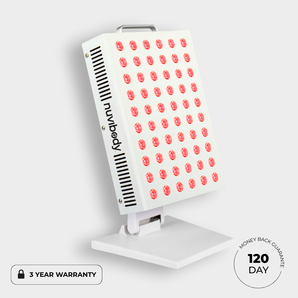
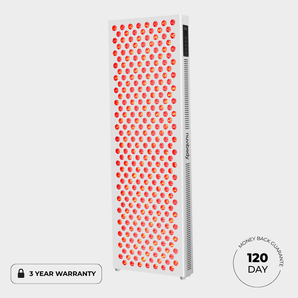
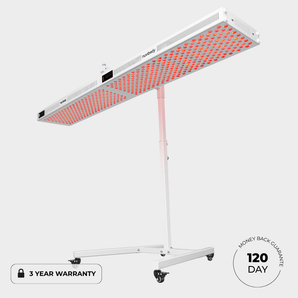
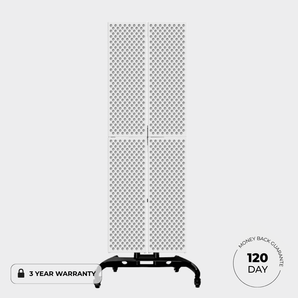
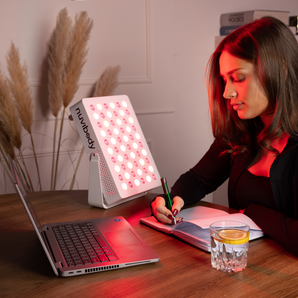
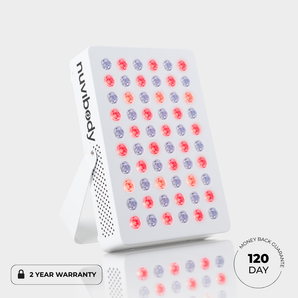
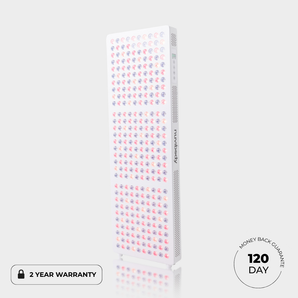
For visible results on skin, you need a panel or mask with the right wavelengths and sufficient power to deliver the effective dose. For targeted facial treatment, similar to protocols in clinical research, the AURA+ LED Mask works best. For full-body treatment with multiple wavelengths (630, 660, 810, and 850nm), the CORE 1500 is the most versatile choice. For targeted skin treatment with more flexibility, the CORE 300 is a strong option. For those who want to explore without a large investment, the LITE 300 is an accessible starting point.
All Nuvibody panels comply with CE, RoHS, and EMC standards and come with a 120-day risk-free home trial. Unsure which model suits your goal? Call +31 85 250 2810 or email support@nuvibody.com, and we'll help you decide without any sales pressure.
Conclusion
Before-and-after results of red light therapy are real, and in clinical research, they are even measurable in concrete figures: pores -32.8%, crow's feet -38.3%, sebum -70.3% after 3 months of consistent use (Couturaud 2023). What Nuvibody customers report largely aligns with this: skin improvement within 4-8 weeks, sleep within 1-3 weeks, pain relief within 1-3 sessions to weeks depending on the condition.
The best way to see your before-and-after is not by looking at photos of others, but by consistently treating yourself for 12 weeks and documenting your own progress. This is what the 120-day trial period is for.