

Is red light therapy the same as infrared?
Short answer: no, but it's more nuanced than it seems. Red light therapy and infrared therapy are often used interchangeably, even in product descriptions and blogs. This causes confusion. On this page, we will clearly explain the difference.
What is red light?
Red light is visible light with wavelengths between roughly 620 and 700 nanometers (nm). In red light therapy, wavelengths of 630 nm, 660 nm, and 670 nm are primarily used. This light is visible to the naked eye as a red glow and penetrates the upper skin layers, approximately 1 to 2 mm deep. Its effect is mainly in skin-related applications: collagen production, wound healing, and skin rejuvenation.
What is infrared?
Infrared light is a collective name for several types of light: near-infrared (700 to 1400 nm), mid-infrared (1400 to 3000 nm), and far-infrared (3000 to 10,000 nm). They all work differently and are not interchangeable.
Mid- and far-infrared primarily work thermally: they heat tissue and are often used in infrared saunas to promote sweating and blood circulation. This is what people often think of when they hear "infrared," the classic red sauna lamp.
Which infrared IS included in red light therapy?
Only near-infrared is used in red light therapy because it can be absorbed by cells to stimulate energy production (ATP).
Near-infrared light penetrates deeper than red light. The longer wavelengths reach cells deep within the body, including muscles, joints, and bones, beneath the skin. The most commonly used wavelengths are 810 nm, 830 nm, and 850 nm. This light is not visible to the naked eye, which can make a panel appear almost "off" during a near-infrared session.
The difference summarized
Red light (630 to 670 nm) works superficially and targets the skin. Near-infrared (810 to 850 nm) penetrates deeper and reaches muscles, joints, and organs. Far-infrared (as in a sauna) works via heat and has a different mechanism of action than both other forms.
Red light therapy does not work through the heat pathway like sauna lamps, but by charging mitochondria and increasing cellular energy.
Why do most devices combine both?
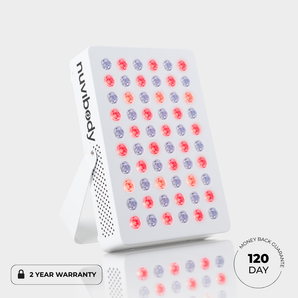
Because red light and near-infrared complement each other. Red light addresses skin issues, while near-infrared supports deeper tissues. Most modern panels, including those from Nuvibody, combine both wavelengths so you can benefit from the full therapeutic range in one session.
Red light therapy vs. infrared sauna
This is a frequently asked question. The main difference is that red light therapy uses light to energize cells, while an infrared sauna generates heat in the body. They are not the same but can be effectively combined.
Want to know exactly how red light and near-infrared work at a cellular level? Read our article on the mechanism of red light therapy.